

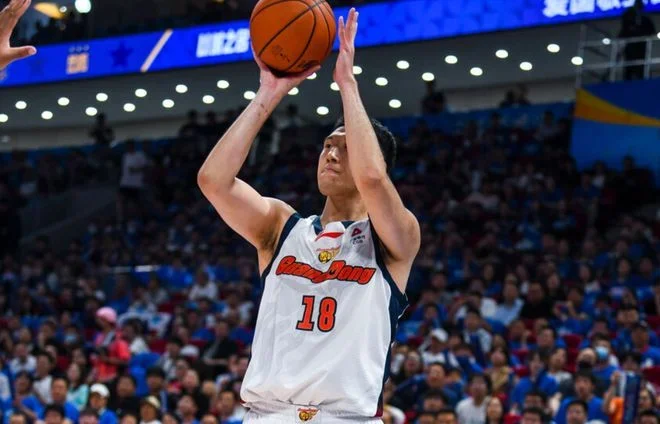
Guangdong suffered a 73-88 road defeat to Beijing, losing the series 1-2 and missing the CBA semifinals for the second consecutive year. The game took a bizarre turn as Guangdong, which controlled the first half and led by 10 points, suddenly collapsed after Zhao Rui’s injury.
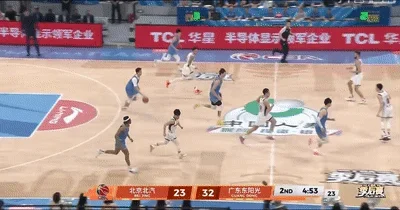
In the second quarter, with 4:50 left, Zhao Rui drove to the basket but collided knee-to-knee with teammate Hu Mingxuan, forcing him to leave the game. Following Zhao’s exit, Beijing launched an astonishing 18-0 run in just four minutes, fueled by Zhou Qi’s free throws, three-pointers from Jermaine, Zeng Fanbo, and Lei Meng, plus layups from Jermaine and Zeng Fanbo. The momentum completely shifted, and Guangdong never recovered.
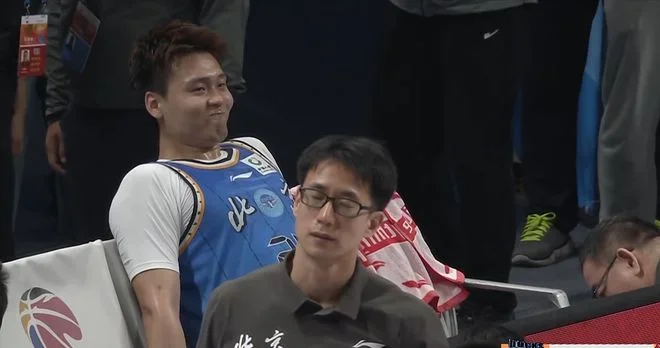
Many fans questioned why Guangdong, despite losing an opponent’s key player, suddenly became disoriented. Guangdong supporters pointed to Hu Mingxuan’s hesitation after Zhao’s injury—he scored 9 points before the incident but none in the second quarter before halftime and only 4 in the second half. Others blamed questionable refereeing, citing Zhou Qi’s repeated free throws, three Guangdong turnovers in that span, and a disallowed 2+1 for Xu Jie.
Beijing fans had a different take, criticizing Zhao Rui’s poor performance throughout the series. In Game 3, Zhao played less than 13 minutes, scoring just 2 points on 1-of-4 shooting with a minus-9 plus-minus. Interestingly, while Zhao was on the court, Beijing outscored Guangdong by 9 points; after he left, his teammates produced the 18-0 run. Some Beijing fans even predicted during the game that Zhao’s injury would be a turning point—a comment that proved prescient.
However, the real turning point was not Zhao’s injury but Beijing’s strategic adjustment. After losing Game 2 due to Guangdong’s hot three-point shooting, Beijing coach Xu Limin (or Li Nan) shifted focus to attacking the paint. Beijing attempted only 21 three-pointers, instead relying on inside scoring from Zhou Qi (12 free throws, 18 points, 8 rebounds, 4 blocks) and McGee. Moreover, after Zhao’s injury, Xu Limin introduced little-used guard Williams, who played just 15 minutes but dished 5 assists and posted a +14 plus-minus. Fans noted that Williams’ unselfish play and vision activated Beijing’s offense, especially his combination with Zhou Qi.
In the end, Guangdong’s three-point shooting was poor (8-of-31, 25.8%), and the team’s overreliance on perimeter scoring proved fatal against Beijing’s size advantage. While Zhao Rui’s injury was a visible catalyst, the deeper reason for Guangdong’s collapse was Beijing’s tactical shift and the emergence of Williams as a difference-maker.
