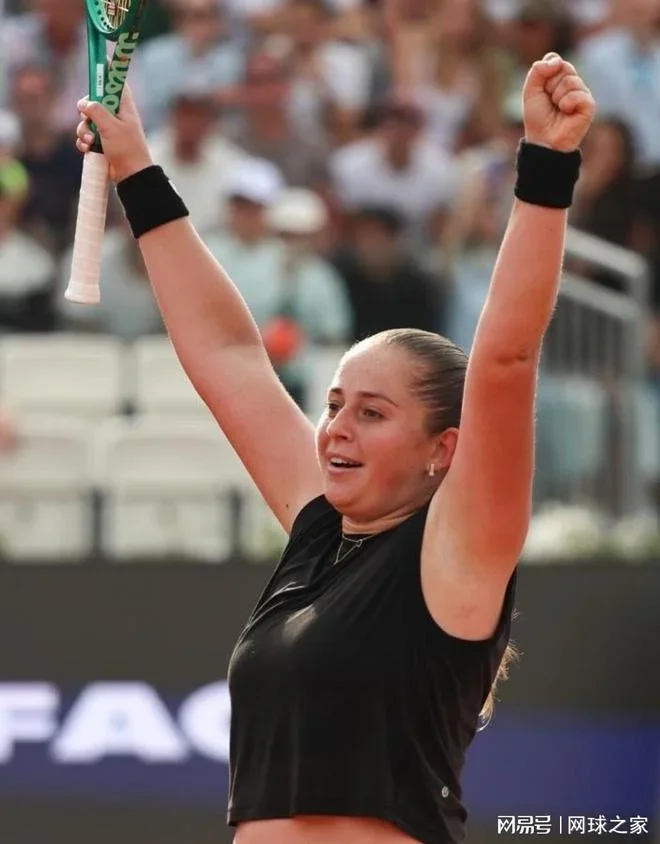

The quarterfinal lineup at the Rome Masters is set, and while headline-grabbing news is scarce, drama is plentiful. On one side, Ostapenko steals the spotlight with her sharp tongue; on the other, Swiatek cruises past Osaka, coached by her former mentor Wiktorowski, in a match loaded with subtext. But the real question remains: can Swiatek finally overcome her “quarterfinal curse” this season?
**Ostapenko’s Mouth Never Disappoints**
Let’s start with the match between Ostapenko and Kalinskaya. The scoreline was one-sided: 6-1, 6-2, a routine win at first glance. However, all the drama unfolded after the final point.
Kalinskaya walked straight to the umpire’s chair to shake hands, completely ignoring Ostapenko—a moment that sparked widespread discussion.
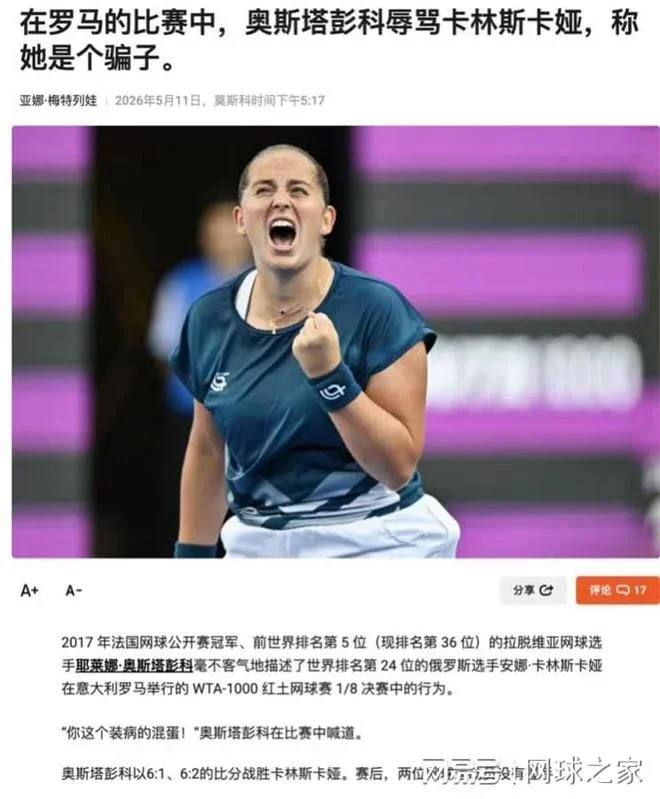
Russian media outlet Championat later reported the backstory. Kalinskaya had taken a medical timeout after the first set, which immediately triggered Ostapenko. In her world, such a move is a ruse—a tactic to stall and fake an injury. Championat directly quoted Ostapenko’s expletive: “You faking bastard!”
Imagine the scene on a clay court—swearing directly at an opponent across the net is extremely rare in professional tennis. The WTA has its share of drama, but few can deliver such in-your-face verbal assaults as consistently as Ostapenko.
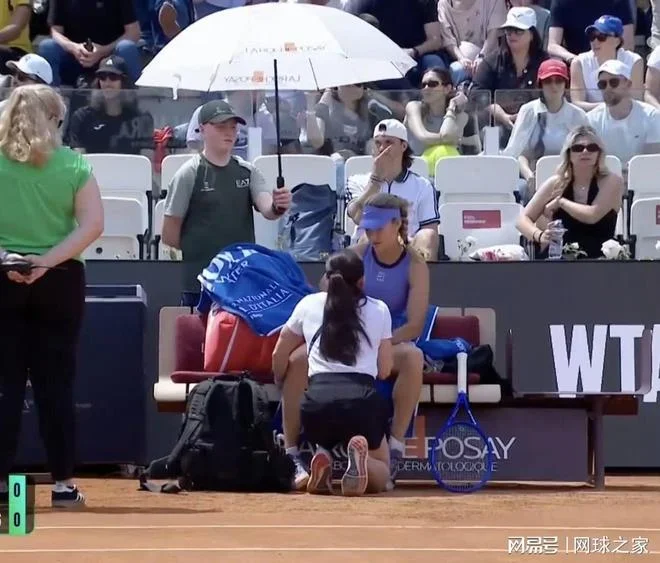
As a result, Kalinskaya bypassed the traditional net handshake and headed straight to her chair. Ostapenko, meanwhile, didn’t stand idle; she approached the umpire to argue, essentially saying, “See, I told you she was faking.”
Whether Kalinskaya truly faked an injury is impossible to judge from afar—only the player knows her own physical condition. But one thing is certain: the rivalry between these two, already simmering since Dubai, has escalated into one of the most explosive personal feuds on the WTA Tour. Their next meeting is a must-watch for fans.
**Swiatek: Stuck in the Quarterfinal Rut Again**
If Ostapenko’s drama is spicy enough, Swiatek is starring in a far more agonizing psychological thriller.
Swiatek’s match against Osaka looked like a potential thriller beforehand—some thought Osaka might seek revenge. But the result was a no-contest: 6-2, 6-1, wrapped up in just over an hour. Osaka had no answer on clay, and Swiatek extended her winning streak against the Japanese star to three matches.
Wiktorowski, Swiatek’s former coach, remains part of Osaka’s team. But since Osaka’s runner-up finish at a US Open warm-up event and quarterfinal run at the US Open last year, she has gone quiet, with no notable results since. Still, a reunion between former coach and player always carries an edge—just think of Thomas Hogstedt coaching Sharapova and the fierce battles Li Na had with her. Perhaps Swiatek felt an extra incentive to prove herself.
But despite the dominant scoreline, everyone knows what Swiatek reaching the quarterfinals means again this season: “Quarterfinal specialist.”
In 2026, Swiatek has been locked into that label. Let’s list them: Australian Open—quarterfinal; Doha—quarterfinal; Indian Wells—quarterfinal; Stuttgart—quarterfinal; now Rome—quarterfinal again. Five quarterfinal appearances, five losses at the semifinal doorstep, not a single breakthrough.
This is no coincidence—it’s a curse.
Looking at how she lost these matches only deepens the frustration: losing to Rybakina, being overturned by Sakkari, upset by Svitolina. In many cases, she had opportunities but suddenly lost focus in key moments. The feeling of “how could Swiatek possibly lose?” has occurred so frequently this season that fans now suffer from PTSD. Every time she reaches the quarterfinals, comments flood in with “it’s over” and “she’ll choke again.”
This isn’t just a form slump—form slumps last a tournament or two. She consistently falls at the same stage, which points to a psychological block. Her new coach, Roig, may have made technical adjustments, but clearly hasn’t helped her overcome this mental hurdle.
And now, her potential last-eight opponent in Rome is Pegula—arguably the toughest test.
First, consider Pegula’s incredible season: a 28-5 record, and Rome marks her seventh tournament quarterfinal of 2026. If Osaka was like a multiple-choice question with known solutions, Pegula is a complex problem. Her game is remarkably steady, with a large defensive coverage and willingness to engage in long rallies. Moreover, her offensive game has improved significantly this year. For Swiatek, who is still in the transition phase of technical changes, facing a player who “won’t die and attacks aggressively” is the absolute worst matchup.
The significance of this match cannot be overstated. If Swiatek wins, she finally breaks the dreaded “no semifinal” curse and heads to Roland Garros with full confidence. If she loses, it will be her sixth straight quarterfinal exit, casting a heavy shadow over her French Open title defense.
But perhaps, seen from a different angle, curses are meant to be broken. Swiatek’s determination in Rome shows she still has that fighting spirit. Beating Osaka was just a warm-up; the real test has only